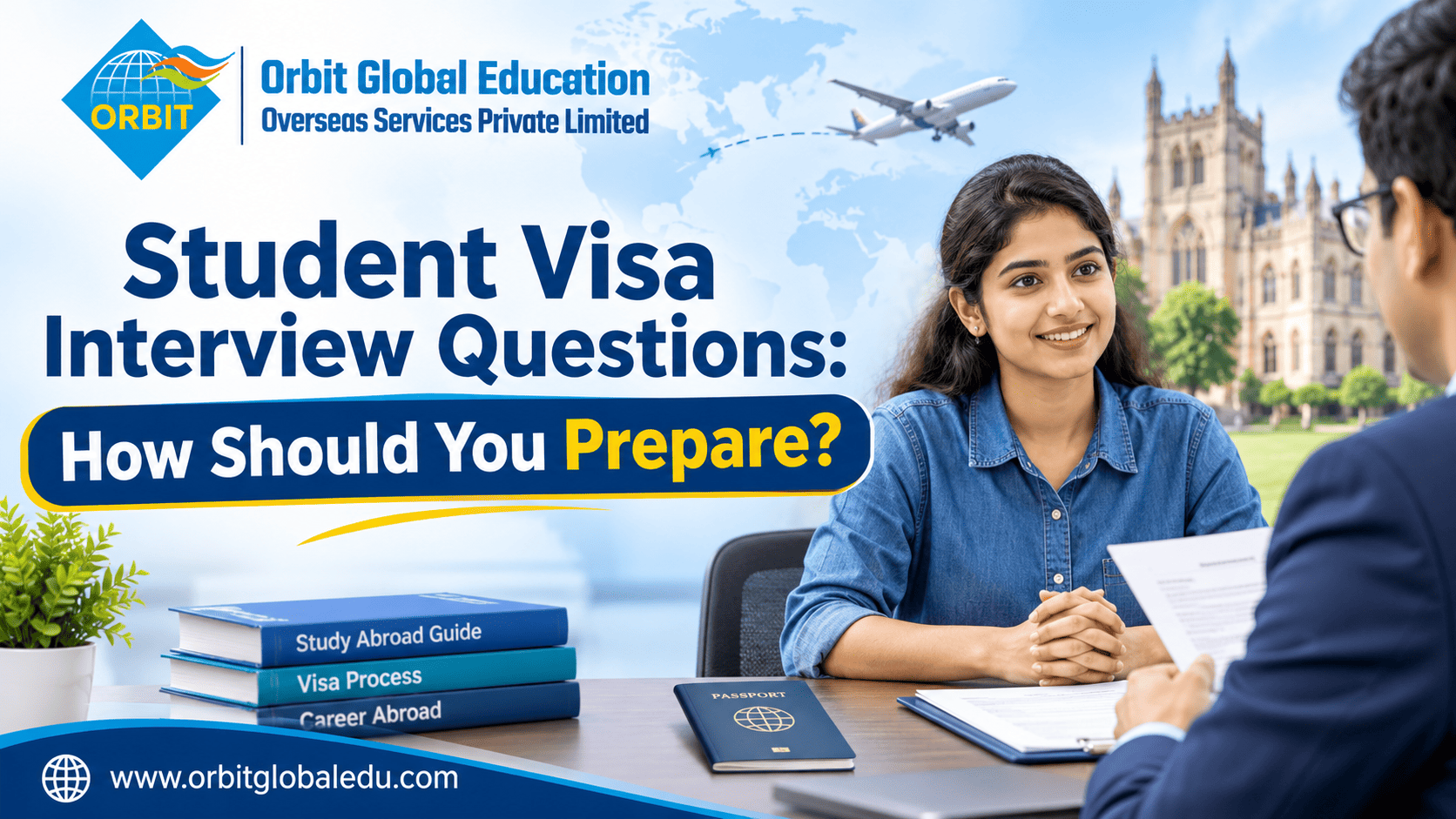
The university acceptance letter has now been obtained, money issues have been sorted out, and all documentation has been sent. The next and most nerve-wracking step will be the student visa interview.
You are likely to feel nervous about it, considering you have no idea what exactly the visa officer would ask you during the interview. While you may be well-prepared with your paperwork, the oral communication will be a totally new ball game.
However, the thing is that you do not have to get prepared to answer hundreds of questions. All you have to do is understand your plans for studying abroad and be aware of your finances.
This is how you can get ready for your student visa interview without increasing its level of stress.
What Does the Visa Officer Want to Know?
The majority of questions asked during student visa interviews revolve around:
- Why have you chosen this course and university?
- How will you pay for your education and living expenses?
- What are your plans after completing your studies?
- Do your answers match the information in your application?
The individual wants to find out whether or not you are a genuine student and also have all the qualifications to support your visa.
There is no need for complex language or even complicated answers because all that is needed is a simple explanation.
Common Student Visa Interview Questions
Even though different countries have different questions and may ask for different information, here are some things that you can expect to be asked:
- Why did you choose this particular university and course?
- Why do you want to study abroad instead of in India?
- How does this course relate to your previous education?
- Who is sponsoring your education?
- What is your sponsor’s occupation?
- How much are your tuition fees and living expenses?
- What are your career plans after graduation?
- Have you applied for a visa before?
- Have you ever had a visa application refused?
This might seem like an easy set of questions to answer, but it is actually pretty difficult when you are not prepared to answer them.
For instance, if the immigration officer asks you why you picked a particular university, simply telling him that the university is good will not do. You need to know how to back up your choice of the course you have applied for.
The more familiar you are with your own application, the better off you will be.
Make Sure Your Answers Match Your Documents
Another aspect that students usually miss out on is the significance of ensuring consistency between the answers and the application.
Let us say your SOP mentions that your goal is to become a data analyst in the future. In the interview, however, you fail to give a proper answer as to why you have opted for this course.
Such inconsistencies might put a question mark on your study plans.
The same goes for your tuition fees, the occupation of your sponsor, educational background, and plans.
That is the reason why your SOP must include facts based on your real interests and plans. Whether you do it yourself or hire an SOP writing service for students, you must know all the details included in your SOP.
You do not necessarily need to reproduce the content of your SOP in the interview. You must just be able to present the same information in your own words.
Know Your Financial Details & Documents
Money is an important factor in many student visa applications.
Prior to going for the interview, make sure you read your admission letter, bank statements, and other educational loan documents.
Make sure you know:
- Your total tuition fees
- Your estimated living expenses
- How much you’ve already paid
- Who is funding your education?
- Your sponsor’s occupation and source of income
You are not required to remember all the figures, but you must know the key facts.
For example, if you are being educated by your parents’ sponsorship, then you should have information about what your parents do and how your studies are funded.
In case you have taken an educational loan, you must know the amount of the loan and how it helps you meet your expenses.
Further, in case you have taken a gap year and switched over to another discipline of education, you must give a clear explanation for that. There is no requirement to make things too complex. You just have to give reasons.
Different Countries Have Different Visa Requirements
Before preparing for the interview, make sure you familiarize yourself with the visa process for the country in which you are going to study.
These requirements apply to study visas, and in some cases, applicants may not be required to attend an interview.
USA: Interviews for student visas are usually based on the student’s educational plans, financial standing, and his/her eligibility for the visa. One is expected to also be prepared to talk about one’s intentions after graduating from school.
UK: Some students may be required to appear for a credibility interview where questions can relate to your selected program, university, academic credentials, financial situation, etc.
Canada: Applications for study permits are normally evaluated by the documentation provided, but where required by the immigration officer, an interview might be requested. You should always be ready to explain the purpose of your studies, financing, and the whole application process.
Australia: The Genuine Student requirement applies to students applying for a visa. There will be times when immigration requires additional information from you, so it will be better for your study program and purposes to be known.
As there can be different visa policies, it is important to know what the current immigration policies are.
Practice Speaking Instead of Memorizing Answers
While giving answers to interview questions by just reading and thinking about the questions is easy, speaking them out loud is something else entirely.
There is no doubt in your mind about the reasons behind joining your university. But when suddenly asked, you might face difficulty in expressing yourself.
This is why it is necessary to practice saying your answers out loud.
Have your friend or relative do a practice interview with you. One can consider another way, which entails taping oneself answering questions.
One has to make sure that one’s responses are clear and also does not spend too much time on explanation.
One should not try to memorize the whole answer since it may be very discouraging for one when one forgets even a line.
Instead, one should be able to make sure that one remembers the most important parts that one needs to convey clearly.
Make sure that your answers relate to the question that is being asked. The visa officer can seek clarification if needed.
When Should You Consider Professional Visa Assistance?
Certain students will have simpler applications and will be sure about handling the procedure all alone.
While certain other students may face problems because of the gap in education, previous visa denials, financial issues, or even choosing the right program.
Here comes the role of study visa assistance in India, which can help you understand the process and prepare your documents.
But one thing should always be kept in mind: the assistance should never involve making any untrue statement or hiding certain information.
Orbit Global Education provides guidance in the process of admission, visa application, finance, and interview preparation.
Consulting experienced student visa counselors from Hyderabad will be helpful to students in order to understand their requirements and prepare for any potential problems.
As far as visa processing for studies abroad is concerned, it is better to begin sooner so that you can have time to verify everything.
What Should You Do on the Interview Day?
After preparing for many weeks, the last thing you would want to have on the day of your interview is feeling rushed.
Make sure to confirm your interview appointment in advance and familiarize yourself with the interview location.
Organize your papers in accordance with the guidelines offered by the consulate or embassy. Dress well, come on time, and do as you are instructed at the interview venue.
When taking an interview, one should pay attention and then respond.
If the question is not clear, politely request that the officer repeat or clarify the question. It is okay to seek clarification.
First and foremost, never make up anything or say something wrong just because you think you have to answer right away.
Always remember that telling the truth is always better than giving the best answer possible.
FAQs
A. The duration varies depending on the country and your application. Some interview processes are shorter, but others can be longer if more questions have to be asked.
A. No. Know your subject, money situation, and plans so you can speak about them spontaneously rather than recite pre-memorized answers.
A. Ask politely for clarification if you do not understand the question or need it to be repeated. You do not want to give a wrong answer.
A. Yes, this may have an impact on your application. You should be honest and discuss changes in your situation.
A. No. Interview requirements may vary from one nation to another and depend on the type of application. Some students may be accepted based on their documentation alone without undergoing interviews.
Conclusion
Being interviewed as a student visa holder may seem intimidating, considering that you have put in much effort into preparation. However, there is no need for you to let nerves get to you and negatively impact your performance.
Be aware of the course that you are enrolling in, understand your financial situation, and prepare an explanation of why you want to study abroad.
The interviewer is not interested in hearing from you an experienced speaker who can give all the answers to any question; he just wants to hear about you as a student.
Orbit Global Education is here to assist you with your visa interview and application preparation.
Follow us on Instagram.