
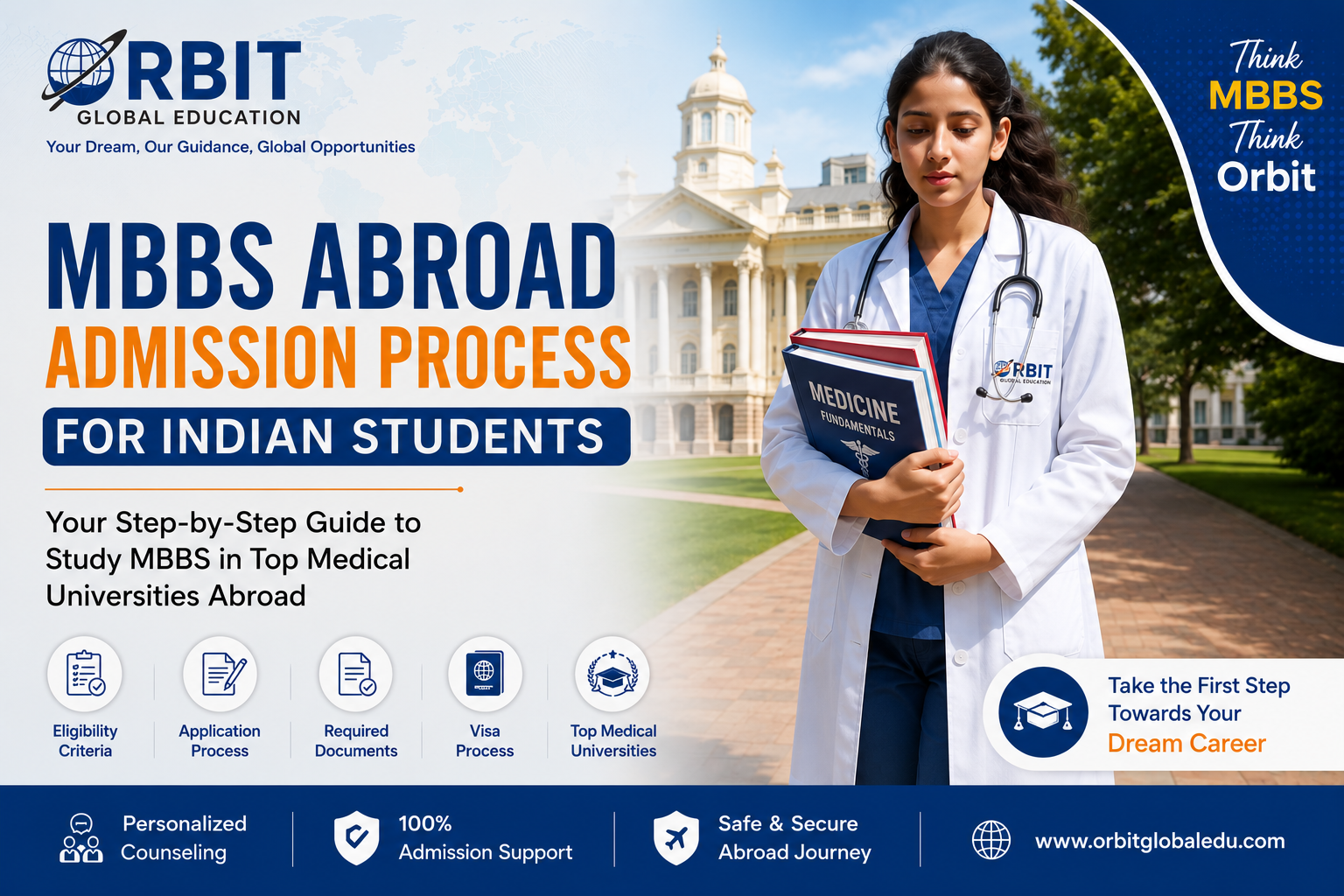
Annually, lakhs of students from India apply for NEET with aspirations of becoming a doctor, but only a small percentage succeed in getting into a decent government medical college in their home country. Competition is fierce, seat vacancies are few, and tuition in private medical colleges in India requires hefty donations, which the common Indian middle class cannot pay. It is no wonder that an increasing number of students have started considering options to pursue their MBBS degrees abroad, and in truth, the decision is not just a “plan B.”
Here is a quick description of the process of admission that you may consider if you wish to take this route.
Step 1: Clear the NEET Exam
It is absolutely mandatory. No matter which country you select for your MBBS abroad, the NEET criteria continue to apply to get your MBBS degree recognized in India later on. You may not have to score as highly as you would need in the case of the best government colleges in India, but you will definitely need a qualifying score according to the standards set by the NMC.
Step 2: Shortlist the Right Country and University
This is where most of the students find themselves getting confused, and to be honest, this is where help is needed the most. Many countries, such as Central America, Russia, Georgia, Kazakhstan, Kyrgyzstan, and the Philippines, have been chosen by Indian students due to cheap tuition fees, good quality of education, and universities that are recognized by NMC. Each country has its own strengths – some provide English medium studies from day one, some have cheaper expenses, and some have an easy process of obtaining visas. It is for this reason that choosing to work with qualified consultants for studying MBBS abroad consultants in India can save you time and effort.
Step 3: Know the Eligibility Requirements
Each college has its own minimum eligibility requirement, which normally includes a certain percentage in Physics, Chemistry, and Biology in the 10+2 examinations, plus an eligible score on the NEET test. The age requirements, along with other admission conditions, differ a bit from one nation to another. It is best to check first before deciding on a college for your MBBS abroad eligibility for Indian students.
Step 4: Apply and Get Your Admission Letter
After selecting your university, the process of applying to it becomes rather simple since you only have to submit all your academic records, your NEET score card, your passport photocopy, and a couple of pictures. Your application will be processed promptly by the universities, and you will receive the admission/invitation letter within a few days. This letter is then the basis of your visa application.
Step 5: Visa Application and Arrangement of Travel Plans
With everything set regarding the admission letter, you need to obtain a visa for the destination you are planning to visit. This process will involve submitting financial and health certificates and, sometimes, attending interviews with the embassy of your choice, without making any mistakes in the process.
Step 6: Pre-Departure Preparation
However, before you get airborne, there is a list that must be ticked off, including arranging accommodation, currency exchange, insurance, as well as knowledge of the local culture and climate. Students often underestimate this part; however, proper preparation will definitely make your move to another country much easier.
Why Guidance Matters
The whole admission procedure for MBBS abroad is not difficult to understand, but it is a process that has quite a few components – NEET compliance, choice of universities, documentation, visa deadlines, and verification of recognition by the NMC. Any mistake made here may end up in losing an entire year or even getting a degree that cannot be used in one’s country due to its unrecognized status. Hence, dealing with competent MBBS admission abroad consultants who know their way around NMC and universities is crucial.
FAQs
1. Will my overseas MBBS degree be accepted in India?
A. Yes, but on the condition that the university is recognized by NMC and you pass the FMGE after you return to India, then your degree will be perfectly acceptable for practicing in India. Therefore, the reason why recognition of NMC before choosing a university is so significant for eligibility for an overseas MBBS degree.
2. Should I give NEET to pursue MBBS abroad?
A. Yes, irrespective of whether you pursue your education in foreign universities, the requirement of NEET for pursuing an MBBS degree abroad remains the same. In fact, you will have to give NEET to get admission to foreign universities and subsequently clear the FMGE to be a doctor in India.
3. Which countries should I consider when pursuing an MBBS degree abroad?
A. There are various countries, some common examples being Russia, Georgia, Kazakhstan, Kyrgyzstan, and the Philippines, owing to low fee structure, recognition by NMC, and education in the English language. In the end, the right country depends on your budget, safety, and curriculum, which is why the services of consultants for MBBS abroad in India can be very helpful.
4. How much does it cost to study MBBS outside the country?
A. The cost depends upon the country of the MBBS program one wants to join; the fees are usually somewhere between a few lakhs and 20-25 lakhs for the whole course period, and it is significantly lower than the private medical colleges’ fees in India.
5. What makes it necessary to get consultancy services for the process rather than directly applying?
A. Even though there can be some direct applications, consulting with experts for MBBS admission abroad ensures that you do not fall into any errors, such as inappropriate selection of universities, incomplete paperwork, visa complications, and even selecting a non-NMC-recognised college. Moreover, a good consultant can help with the SOPs and even visa processing.
Final Thoughts
Going for an MBBS abroad is not a compromise anymore for many Indians; this path has become truly a viable option for studying medicine without having to take up costly donation seats in India. Provided you have all the necessary information at hand, coupled with proper planning and advice from trusted sources, it becomes quite doable. Just be thorough with your research and ensure everything falls into line according to NMC standards to ensure the validity of your medical education.
Follow us on Instagram.