Every year, many Indian students travel abroad to pursue their dream of becoming doctors. No wonder, since the number of medical colleges is limited within the country and the costs involved in obtaining an MBBS degree at private colleges in India are quite high. Studying MBBS abroad seems to be one of the most sensible choices for earning a globally recognized medical degree. However, before embarking on the exciting journey of preparing for the journey abroad and finding a place to live, one should think about one important thing: document preparation.
If you are wondering which documents you will really require, you are certainly not alone. It is, in fact, the most frequent question that our team receives from parents and students who come to our office perplexed as to how to study MBBS abroad as an Indian.
Why Documentation Matters So Much
The universities abroad, particularly the ones recognized by the NMC in countries such as Russia, Georgia, Kyrgyzstan, and Uzbekistan, have quite a rigid admission procedure. If you miss out on one single document or get it attested wrongly, you may end up waiting for a number of weeks before being admitted, which could be as long as the next academic intake period.
The Core Documents You’ll Need
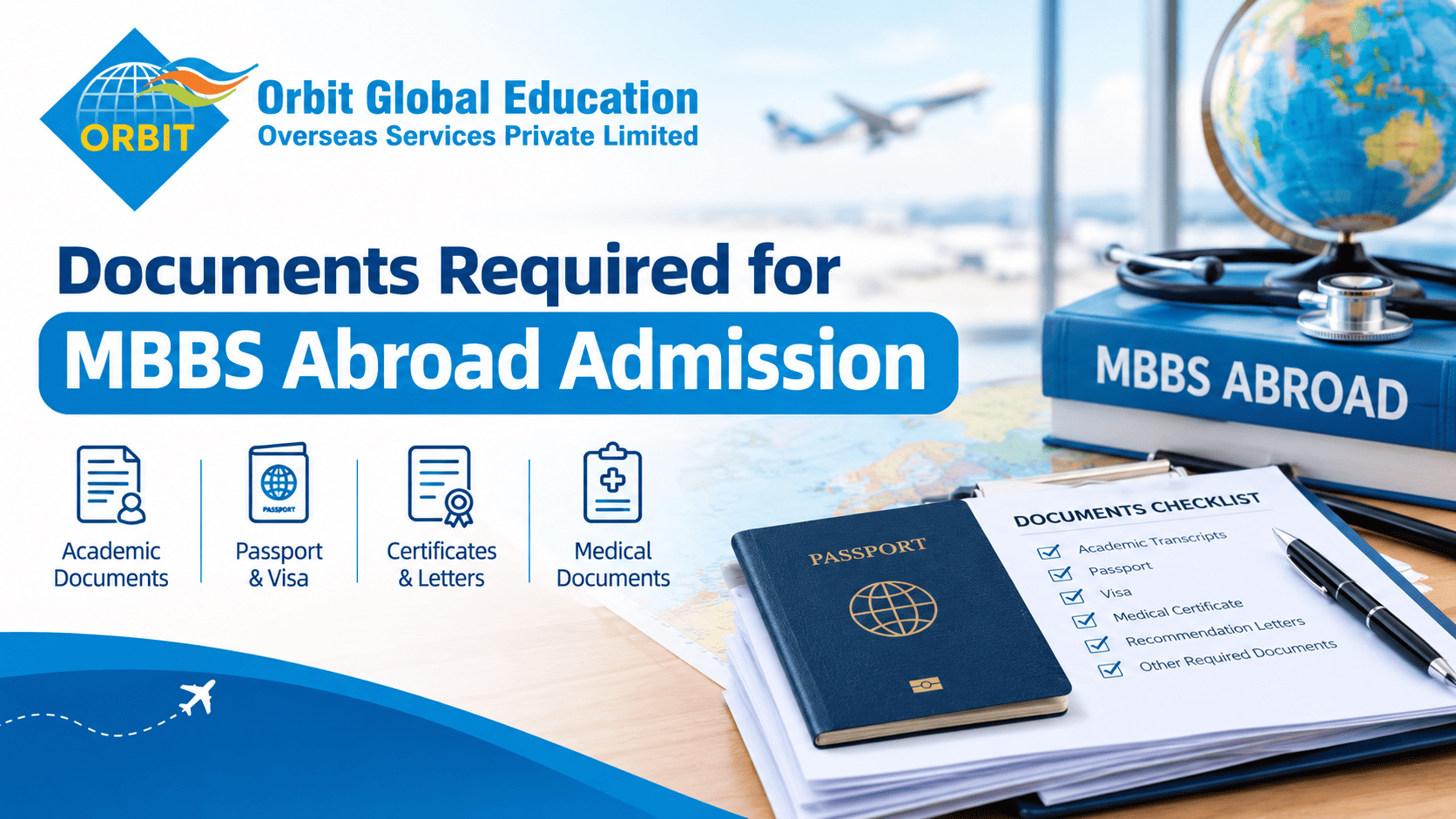
Although there might be minor differences between the universities in different countries, the following list encompasses all the requirements of pretty much every university:
- Academic Certificates: This should include your mark sheets for 10th and 12th grade. Medical universities may have specific academic requirements, including minimum marks in Physics, Chemistry, and Biology (PCB), so it is important to check the eligibility criteria of the university and country you are applying to.
- NEET Scorecard: There is no messing around with this one. Since 2018, it has become mandatory for every Indian student who wishes to get recognition for their MBBS degree acquired abroad to have appeared in NEET. Even if the university abroad does not require NEET scores for getting admission, you would have to appear in NEET for the FMGE examination and NMC registration. It is precisely for this reason that knowing about the NEET requirement for MBBS abroad is among the first things we convey to every parent.
- Valid Passport: The passport needs to be valid for 18 to 24 months beyond the time that you travel. In case you do not yet have a passport, it is a good idea to apply right away because it takes time.
- Passport-Size Photographs: There are various photos to be submitted when universities and visa centers demand them to be of a specific format, with a white background, of a specific size, and so on. This does not sound like much, but it actually is one of the most common mistakes made by students.
- Birth Certificate: This proves your age and identity and is necessary for both university admission and visa processing.
- Medical Fitness Certificate: General health check-ups, along with a few other tests, including an HIV test, are compulsory before universities and embassies can allow you to travel to another country.
- Invitation or Admission Letter: Once you have been enrolled in the university, the next thing you will receive is a letter from the university. This letter is important for obtaining your student visa.
- Bank Statements or Financial Proof: Embassies want to make sure that you (or your family members) can pay the tuition and accommodation fees. You need to provide your bank statement, letter of sponsorship, or sanction letter for the educational loan.
- Migration and Transfer Certificates: If you have completed your previous studies under a board or institution other than the one you are applying to, these certificates will confirm that you have successfully completed your previous studies and are eligible for migration.
- Attested and Notarised Copies: Each and every one of the above documents may require attestation at some point by a gazetted officer or the Ministry of External Affairs, according to the embassy rules of the destination country.
A Word on Getting It Right the First Time
Students have been known to lose an entire academic year due to incorrect attestation or late submission of the NEET scorecard. That is why it becomes important to get professional help from experts in MBBS admissions abroad consultants. It is not only about filling up forms; it is also about understanding the requirements of each university and embassy and ensuring there are no errors.
How Orbit Global Education Can Help
At Orbit Global Education, we have been assisting a lot of students in going through this process step-by-step, starting from their first checklist of documents to their first day on the campus of their university. Our consultants are aware of the most recent guidelines provided by NMC, embassies, as well as the universities themselves in countries such as Russia, Georgia, Kyrgyzstan, and Uzbekistan.
If you are really keen on pursuing MBBS overseas and want a hassle-free admission process, contact us at Orbit Global Education. We will guide you through all the paperwork and processes involved so that all you have to think about is realizing your dream of being a doctor.
FAQs
A. Yes. Even though the foreign university where you are applying may not need your NEET scores at the time of admission, you certainly will need to have a qualifying NEET score if you want your degree to be acknowledged in India and to appear for the FMGE/NEET exam.
A. Typically, students must secure at least 50% aggregate marks in Physics, Chemistry, and Biology/Biotechnology in their Class 12 qualifying examination. For candidates belonging to SC, ST, and OBC-NCL categories, the minimum requirement is 40%. They must also meet the NEET UG qualifying criteria.
A. This varies according to the country and authority that is attesting the documents; however, the process may take up to a few weeks. It is always better to initiate the process of attestation after receiving an admission offer.
A. In most cases, universities accept notarized or certified copies when you apply, but you have to present the original ones when you travel because of visa and university requirements.
A. Certainly. The best study abroad consultants not only tell you what documents to prepare but also assist you in avoiding common pitfalls regarding attestation, formatting, and submission deadlines, among other things that could delay your admission process.
Conclusion
Preparing your documents is the foundation of your entire MBBS abroad experience, even if it’s not as exciting as choosing a university or thinking about your first day there. With just some preparation and precaution, you can save yourself from many difficulties later on. It doesn’t matter whether you require a NEET scorecard, passport, or any attested certificates; all you need to do is prepare yourself in advance and ask for help when required. With the right guidance, the entire process will become easy and effortless.
Follow us on Instagram.